
On diet, activity, and the recalibration of “healthy”
The most useful frame I have found for thinking about diet and exercise is this: what we call “normal” today is, in historical terms, a wildly extreme position. The healthy person of 2026 eats a quantity of sugar that would have been physically impossible to consume two hundred years ago, and moves at a level that would have struck anyone who had to feed themselves as borderline immobile. We have built a baseline so far from anything humans have lived with before that approximating the historical norm now reads as fanaticism.
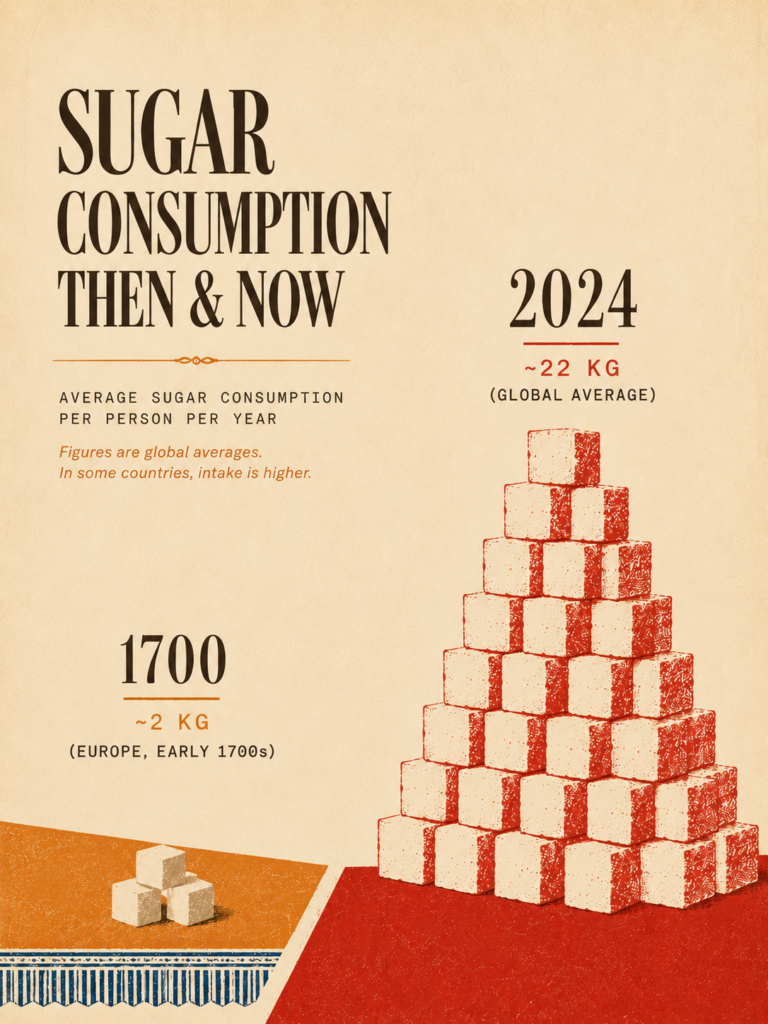
The numbers make this concrete. Europeans in 1700 ate roughly 2 kg of sugar per person per year. Today the figure is 30 to 50 kg in developed countries — a fifteen to twenty-five fold increase. Refined seed oils were essentially absent from the human diet before 1900 and now account for around a fifth of Western calories. On the activity side, agricultural laborers expended four to five thousand calories a day. Current public health recommendations of 150 minutes of moderate activity per week — which most people still fail to meet — would have been an unimaginably sedentary existence to almost anyone born before the war. A person who works out five times a week is roughly matching the activity level of a moderately lazy 1850 farmhand.
None of this happened by accident. Food companies have spent decades gradually escalating sugar in everyday products, recalibrating each generation’s tolerance upward. Cars, elevators, desk work, and screens removed incidental movement so completely that we had to invent “exercise” as a separate concept and market it as optional. The result is a baseline that is a marketing artifact, not a health one. People are not choosing this in any deep sense — they are inheriting an environment calibrated by entities that profit from the calibration.
The activity side connects to the diet side in a way that is underappreciated. The body works something like a fire: when there is real heat, it burns through almost anything you throw on it; when it is barely smoldering, even small amounts of the wrong fuel clog the system. A body moving at historical levels handles a much wider range of foods than a stationary one — carbs, fats, fruit, dairy, fatty meat are all well-tolerated by an active body and poorly tolerated by a sedentary one. Restoring activity is not just about burning calories. It is about expanding what counts as a reasonable diet in the first place.
The social perception piece is what makes this hardest to see from the inside. When the median is pathological, anyone aiming at actually healthy looks like an extremist. The person who does not drink soda, brings food from home, walks instead of driving — they are not intense. They are approximating what a schoolteacher in 1900 did without thinking about it. The intensity is an artifact of how far the median has drifted, not a property of their behavior.
The point of all this is not to romanticize the past. Modernity is precisely what makes the better option available — it is the first time in history a person can eat close to how humans always ate while still benefiting from medicine, sanitation, food safety, and dental care. The hunter-gatherer did not get to choose. We do. Most of us are just choosing badly by default, because the default is calibrated against us.
The useful question is not whether your habits seem strict to your coworkers — their baseline is the artifact. It is whether they would seem strict to your great-grandparents. That answer is closer to what your body actually expects.